
Tempered Glass Retail Displays: How to Judge Safety and Durability
Time
Click Count
Tempered Glass Retail Displays: How to Judge Safety and Durability
Selecting tempered glass retail displays requires more than checking appearance or price.
Real value comes from verified safety, structural strength, and reliable long-term performance.
In commercial settings, weak glass systems create injury risk, maintenance cost, and brand damage.
That is why tempered glass retail displays should be judged with engineering logic, not visual appeal alone.
This guide explains the practical criteria that matter when comparing suppliers, designs, and performance claims.
Why Safety Comes First in Tempered Glass Retail Displays
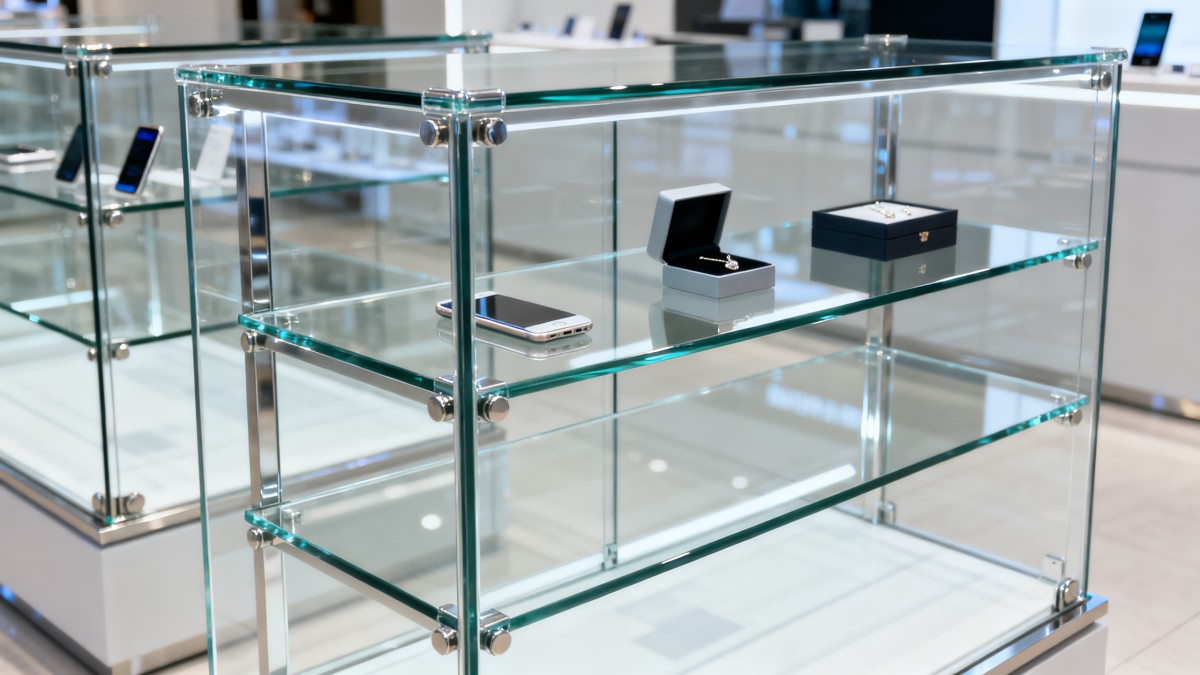
Tempered glass retail displays are common in cosmetics, electronics, jewelry, and premium lifestyle stores.
These environments demand clarity, clean lines, and a premium look.
Still, appearance means little if the display cannot tolerate real store traffic.
Customers lean on shelves, staff restock fast, and cleaning teams use repeated pressure.
A safe system must handle these daily loads without edge failure, cracking, or hardware loosening.
Tempered glass is stronger than ordinary annealed glass, but that alone is not enough.
The full display must be assessed as a system.
That includes glass thickness, panel size, support spacing, cutouts, fittings, and installation conditions.
In practice, safety failures often start at stress concentration points.
Corners, drilled holes, polished edges, and metal contact areas deserve close review during supplier evaluation.
Check the Tempering Quality Before Anything Else
Not all tempered glass retail displays are processed to the same standard.
A reliable supplier should provide traceable tempering data and inspection records.
Look first at surface compression consistency.
Uneven tempering can reduce impact resistance and increase spontaneous breakage risk.
Flatness is another basic but important signal.
Poor flatness affects shelf alignment, door closure, and the visual quality of illuminated displays.
Wave distortion also matters in premium retail projects.
When lighting hits the surface, roller wave or optical haze becomes easy to notice.
That can hurt product presentation, especially for luxury goods.
Ask for the following quality evidence:
- Tempering process control records and batch traceability.
- Fragmentation test results after controlled breakage.
- Flatness and bow tolerance data for the actual panel size.
- Optical quality photos under store lighting conditions.
- Compliance references to applicable safety expectations or client specifications.
Evaluate Load Capacity as a Real Use Case, Not a Generic Claim
One common sourcing mistake is accepting a generic load statement.
For tempered glass retail displays, load performance depends on geometry and support conditions.
A shelf rated for one span may fail at another.
A thicker panel may still perform poorly if the bracket design creates local stress.
The better approach is scenario-based evaluation.
Review expected product weight, load distribution, shelf depth, and frequency of handling.
Then compare that with engineering calculations or test reports.
Key load questions include:
- What is the safe working load per shelf, not the maximum break point?
- Was the test based on uniform load, point load, or dynamic handling?
- How much deflection occurs at the center under normal merchandising weight?
- Do metal clips, pins, or frames include anti-slip protection?
- Is there a safety factor suitable for high-traffic retail use?
This matters even more in stores with frequent resets.
Displays that survive static testing may still degrade quickly under repetitive loading and unloading.
Look Closely at Edges, Holes, and Hardware Interfaces
Edge treatment is one of the clearest indicators of durable tempered glass retail displays.
A polished edge may look refined, but finish quality must also reduce micro-crack risk.
Chips, uneven grinding, or sharp transitions weaken the panel.
The same is true around drilled holes and cutouts.
These zones experience concentrated stress, especially near hinges or locking hardware.
If tolerances are poor, hardware installation adds pressure before the display even enters service.
During technical review, inspect these points carefully:
- Edge finish type and consistency across all visible and hidden sides.
- Minimum distance from holes to edges and corners.
- Use of gaskets, sleeves, or cushions between glass and metal.
- Tolerance control for locks, hinges, brackets, and door pull fittings.
- Resistance to vibration, repeated opening, and accidental side impact.
This is where many low-cost products lose value.
The glass may be technically tempered, yet the interface design still creates avoidable failure points.
Durability Depends on the Full Retail Environment
Durability is not only about breaking strength.
Tempered glass retail displays must also maintain performance under cleaning, lighting, humidity, and daily contact.
From recent retail upgrades, this point has become more visible.
Stores now expect fixtures to last through multiple layout cycles, not just initial launch.
That means surface durability and maintenance behavior deserve equal attention.
Check whether the display can handle:
- Frequent wiping with commercial cleaning agents.
- Heat exposure from integrated lighting or nearby equipment.
- High-touch fingerprints in beauty, mobile, or jewelry counters.
- Condensation risk in mixed-temperature zones.
- Abrasion around product bases, security tethers, or accessories.
If coatings or films are used, evaluate their aging behavior too.
Peeling, discoloration, and adhesive failure can quickly affect appearance and service life.
For global sourcing programs, ask suppliers how the same tempered glass retail displays perform across different climate regions.
Use Compliance and Testing Data to Reduce Sourcing Risk
Good suppliers do not rely on broad marketing claims.
They support tempered glass retail displays with test logic, standards references, and documented process control.
International projects often require alignment with UL, CE, or client-specific criteria.
Even when a display is not regulated like a machine, evidence still matters.
A stronger procurement decision comes from comparing verified records, not samples alone.
Useful evaluation documents include:
- Material specifications for glass, metal, and interface components.
- Test reports for impact, load, and repeated-use performance.
- Factory quality procedures and outgoing inspection checkpoints.
- Installation instructions that prevent field-induced stress.
- Warranty terms linked to realistic commercial usage conditions.
This also aligns with broader sourcing intelligence practices.
Platforms such as G-BCE add value by connecting fixture performance with technical benchmarking and global commercial expectations.
A Practical Checklist for Comparing Tempered Glass Retail Displays
When options look similar, a structured checklist helps separate reliable products from risky ones.
Use this short framework during RFQ review, sample approval, and factory assessment.
This kind of comparison keeps discussions objective.
It also helps justify supplier selection with measurable evidence instead of general preference.
Final Decision: Judge Performance Over Appearance
The best tempered glass retail displays do more than look clean and modern.
They deliver stable safety, proven durability, and consistent performance across daily retail use.
That usually comes from disciplined tempering, thoughtful engineering, and reliable quality control.
In real projects, the strongest decision is rarely the cheapest sample on the table.
It is the option with clear data, sound construction, and lower lifecycle risk.
If you are reviewing tempered glass retail displays for a new rollout, start with safety evidence.
Then test durability against actual merchandising conditions, not ideal assumptions.
That approach reduces surprises after installation and supports a stronger retail environment over time.
News Recommendations
 Report: Global Kraft Paper Market Forecast to Reach $20.5 Billion by 2033
![51a6ab95581761cc26f4318be6520c15]()
Aris Katos
Future of Carbide Coatings
 How to verify Zigbee compatibility when sourcing lighting sensors
![51a6ab95581761cc26f4318be6520c15]()
Aris Katos
Future of Carbide Coatings
 How do packaging customization options affect minimum order quantities in Europe?
![51a6ab95581761cc26f4318be6520c15]()
Aris Katos
Future of Carbide Coatings
 Transom to Acquire Cree LED in Commercial Lighting Ownership Change
![51a6ab95581761cc26f4318be6520c15]()
Aris Katos
Future of Carbide Coatings
 How to plan customer flow in commercial design planning
![51a6ab95581761cc26f4318be6520c15]()
Aris Katos
Future of Carbide Coatings
 USTR Urged to Permanently Suspend Fees on China-Linked Ships
![51a6ab95581761cc26f4318be6520c15]()
Aris Katos
Future of Carbide Coatings
 How to choose comparable stores for retail benchmarking
![51a6ab95581761cc26f4318be6520c15]()
Aris Katos
Future of Carbide Coatings
 How does anchoring affect modular building wind load resistance?
![51a6ab95581761cc26f4318be6520c15]()
Aris Katos
Future of Carbide Coatings
 Amazon Raises European FBA Surcharge to 2% in Ten Markets From November 2
![51a6ab95581761cc26f4318be6520c15]()
Aris Katos
Future of Carbide Coatings
 How to verify a BPA-free test report for baby products
![51a6ab95581761cc26f4318be6520c15]()
Aris Katos
Future of Carbide Coatings
 China's Mandatory Classroom Lighting Standard GB 7793-2025 Takes Effect November 1
![51a6ab95581761cc26f4318be6520c15]()
Aris Katos
Future of Carbide Coatings
 How order volume affects the price of wholesale poly mailers
![51a6ab95581761cc26f4318be6520c15]()
Aris Katos
Future of Carbide Coatings
 US Imposes 50% Tariff on Certain Canadian PET Resin Imports
![51a6ab95581761cc26f4318be6520c15]()
Aris Katos
Future of Carbide Coatings
 How to read the maximum ratings in a semiconductor datasheet
![51a6ab95581761cc26f4318be6520c15]()
Aris Katos
Future of Carbide Coatings
 University of Maryland Develops Bio-Based Packaging to Extend Avocado and Cucumber Shelf Life
![51a6ab95581761cc26f4318be6520c15]()
Aris Katos
Future of Carbide Coatings
 How to verify a cookware manufacturer's induction compatibility claims
![51a6ab95581761cc26f4318be6520c15]()
Aris Katos
Future of Carbide Coatings
 Omdia Forecasts 11.6% Annual Growth in LED Display Revenue Through 2030
![51a6ab95581761cc26f4318be6520c15]()
Aris Katos
Future of Carbide Coatings
 How to verify a pulp molding packaging factory's production capacity
![51a6ab95581761cc26f4318be6520c15]()
Aris Katos
Future of Carbide Coatings
 Curion Survey: Half of Consumers Frustrated by Sustainable Packaging
![51a6ab95581761cc26f4318be6520c15]()
Aris Katos
Future of Carbide Coatings
 How to assess the credibility of market insight content
![51a6ab95581761cc26f4318be6520c15]()
Aris Katos
Future of Carbide Coatings
 US Removes 50% Additional Tariff on Selected Canadian Packaging Products
![51a6ab95581761cc26f4318be6520c15]()
Aris Katos
Future of Carbide Coatings
 Will a waterproof dimmable LED driver work with your existing dimmer?
![51a6ab95581761cc26f4318be6520c15]()
Aris Katos
Future of Carbide Coatings
 Charter Next Generation Raises Film PCR Use 30%, Advances Food-Grade Applications
![51a6ab95581761cc26f4318be6520c15]()
Aris Katos
Future of Carbide Coatings
 How to choose a dog harness and leash for a dog that pulls hard
![51a6ab95581761cc26f4318be6520c15]()
Aris Katos
Future of Carbide Coatings
 How to respect local customs when negotiating with overseas suppliers
![51a6ab95581761cc26f4318be6520c15]()
Aris Katos
Future of Carbide Coatings
 RFID Recycling Challenges Bring Paper-Based and Chipless Tags Into Focus
![51a6ab95581761cc26f4318be6520c15]()
Aris Katos
Future of Carbide Coatings
 How to choose commercial lighting for offices that reduces glare
![51a6ab95581761cc26f4318be6520c15]()
Aris Katos
Future of Carbide Coatings
 Queue Launches Fully Automated Robotic Pharmacy Kiosk for 30-Second Dispensing
![51a6ab95581761cc26f4318be6520c15]()
Aris Katos
Future of Carbide Coatings
 Can your supermarket store fixtures supplier meet your opening date?
![51a6ab95581761cc26f4318be6520c15]()
Aris Katos
Future of Carbide Coatings
 Shopify POS UI Extensions 2026-10 Adds Virtual Lists and Custom Row Templates
![51a6ab95581761cc26f4318be6520c15]()
Aris Katos
Future of Carbide Coatings
 How to assess smart office furniture suppliers’ North American support
![51a6ab95581761cc26f4318be6520c15]()
Aris Katos
Future of Carbide Coatings
 Aqara Launches Smart Lighting Range to Advance AI Spatial Intelligence
![51a6ab95581761cc26f4318be6520c15]()
Aris Katos
Future of Carbide Coatings
 How to assess demand forecasts in a lighting intelligence report
![51a6ab95581761cc26f4318be6520c15]()
Aris Katos
Future of Carbide Coatings
 Billerud推出PharmaKraft纤维基医药包装材料
![51a6ab95581761cc26f4318be6520c15]()
Aris Katos
Future of Carbide Coatings
 How to assess supplier reliability in global supply chain sourcing
![51a6ab95581761cc26f4318be6520c15]()
Aris Katos
Future of Carbide Coatings
 Omdia Forecasts 11.6% CAGR for Global LED Video Display Market in 2026–2030
![51a6ab95581761cc26f4318be6520c15]()
Aris Katos
Future of Carbide Coatings
 How to verify an LFGB testing laboratory's accreditation scope
![51a6ab95581761cc26f4318be6520c15]()
Aris Katos
Future of Carbide Coatings
 How to assess a workplace interior supplier's installation scope
![51a6ab95581761cc26f4318be6520c15]()
Aris Katos
Future of Carbide Coatings
 What records are needed for an ISO 9001 furniture factory audit?
![51a6ab95581761cc26f4318be6520c15]()
Aris Katos
Future of Carbide Coatings







































