A flexible workspace furniture guide for teams that keep changing
Time
Click Count
As teams expand, contract, and reorganize, choosing the right setup becomes a strategic advantage. This flexible workspace furniture guide explores coworking space furniture solutions, space saving office furniture ideas, and smart office furniture integration to help buyers, operators, and evaluators create agile environments that support ergonomic workplace wellness, hybrid work office layout ideas, and sustainable office furniture trends.
For sourcing teams, facility operators, and business evaluators, furniture is no longer a static fit-out category purchased once every 5 to 10 years. In dynamic offices, mixed-use commercial projects, and flexible work hubs, the furniture layer now influences occupancy efficiency, employee comfort, digital workflow, maintenance cost, and reconfiguration speed. A poor specification can lock a site into high churn costs, while a modular plan can support team changes with less disruption.
This matters across the broader commercial ecosystem that G-BCE tracks, where workspace decisions intersect with international standards, supply chain resilience, and design performance. Whether the priority is reducing square-meter pressure, improving workstation turnover, or aligning with BIFMA-oriented durability expectations, decision-makers need a framework that balances adaptability, lifecycle value, and operational practicality.
Why flexible workspace furniture has become a strategic procurement category
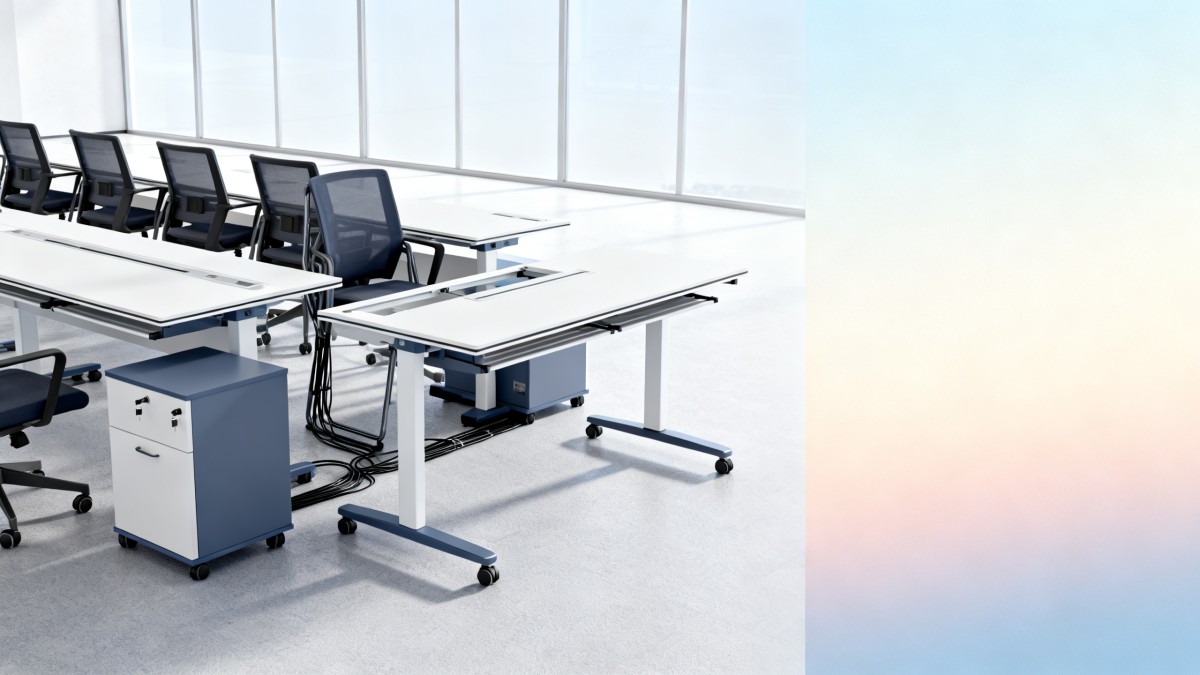
In a conventional office, desks, storage, and meeting tables were often specified around fixed headcount. Today, headcount can shift by 15% to 30% within a year due to hybrid attendance patterns, project-based staffing, and regional expansion. That change has pushed flexible workspace furniture from a design preference into a measurable business category tied to utilization, relocation frequency, and workplace experience.
Coworking space furniture solutions illustrate this shift clearly. Operators need layouts that can transition from open collaboration to focused work in less than 1 business day, not 2 to 3 weeks. Mobile tables, foldable training surfaces, power-integrated lounge modules, and stackable seating reduce reset time and help teams adjust room function without major contractor involvement.
For procurement professionals, the core issue is not simply unit price. It is total adaptability over a 3- to 7-year planning horizon. A desk system that costs 12% more upfront may still produce lower lifecycle cost if it supports cable management upgrades, privacy screen replacement, and workstation resizing without replacing the full frame. This is especially relevant in multinational commercial environments where shipping, local assembly, and replacement lead times vary.
What changing teams demand from furniture systems
Operationally, changing teams create four recurring demands: faster reconfiguration, better density control, stronger ergonomic support, and simpler maintenance. In practice, this means products must move easily, connect safely to power and data, and maintain performance under frequent use cycles. In high-traffic environments, a chair or table may be repositioned 20 to 50 times per month, so hardware durability becomes a functional requirement rather than a premium add-on.
The table below shows how buying priorities differ across common commercial workspace scenarios. It helps evaluators compare where modularity, storage, and technology integration deliver the most value.
The key takeaway is that flexible workspace furniture should be matched to churn rate and use intensity, not just brand image. Environments with frequent layout changes gain the most from mobile and modular systems, while lower-change offices can use a more balanced mix of fixed and adaptable elements.
How to choose furniture for agility, wellness, and efficient use of space
Selection starts with measurement. Buyers should define at least 4 baseline inputs before reviewing product catalogs: average attendance by day, target area per user, planned reconfiguration frequency, and power/data access density. Without those inputs, it is difficult to compare space saving office furniture ideas objectively. For example, a team using desks only 3 days per week has different needs from a customer support unit with 90% daily seat occupancy.
Ergonomic workplace wellness should also be treated as a system decision rather than a chair-only decision. Adjustable seating, sit-stand desks, monitor support arms, foot clearance, and acoustic separation work together. If one component is missing, user comfort declines quickly during 6- to 8-hour work sessions. In fast-changing teams, easy adjustability matters because users are less likely to personalize a shared space with permanent accessories.
Core selection criteria for flexible office environments
A practical sourcing checklist should cover physical dimensions, mobility, serviceability, and finish durability. For compact offices, table depth of 600 to 700 mm and benching systems with integrated cable trays can improve circulation without creating clutter. For collaborative zones, casters with locking mechanisms and lightweight tops can reduce labor time during room conversion.
- Choose modular desk frames that allow width changes or add-on privacy screens instead of one-piece units.
- Specify chairs and soft seating with replaceable upholstery panels or seat pads for longer service life.
- Prioritize storage that can be shared, mobile, or under-desk to reduce fixed cabinet footprints.
- Review load capacity, stability, and edge durability in line with expected daily use intensity.
The next table summarizes common furniture categories and their role in agile planning. It can support early-stage discussions between workplace strategists, procurement teams, and operators managing future changes.
In most projects, the strongest results come from mixing categories rather than standardizing every zone in the same way. A hybrid work office layout idea may use benching for general staff, enclosed focus settings for calls, and mobile meeting furniture for team sprints. That layered approach supports both density and user comfort.
Common buying mistakes to avoid
A frequent mistake is overbuying fixed storage based on old paper-heavy workflows. Another is choosing visually compact furniture that lacks cable management, causing floor clutter and maintenance issues later. Buyers should also avoid assuming all commercial products are equally suited to high-rotation use. For shared environments, joinery quality, finish repairability, and spare-part access within 2 to 6 weeks can be more important than initial appearance alone.
Smart office furniture integration and implementation planning
Smart office furniture integration is most effective when it solves operational friction rather than adding novelty. In flexible workplaces, the most valuable functions are usually power access, booking visibility, occupancy support, and cable discipline. Furniture with embedded charging, sensor-ready cable pathways, or reservable work settings can reduce user confusion and improve adoption of hybrid policies.
From an implementation perspective, buyers should separate digital requirements into 3 layers: furniture hardware, low-voltage or power compatibility, and software or building interface. A desk with integrated charging is only useful if the site has sufficient floor boxes or ceiling power drops. Likewise, occupancy-linked furniture data has little value if facilities teams lack a clear protocol for acting on it every month or quarter.
A practical 5-step rollout model
Most commercial projects benefit from a phased delivery model that limits disruption and reveals issues early. This is especially important when workspace changes must be coordinated with IT, fit-out contractors, and operations teams across multiple sites.
- Audit current attendance, task patterns, and room usage for 2 to 4 weeks.
- Define furniture standards by zone, including dimensions, power needs, and mobility requirements.
- Run a pilot area for 10 to 30 users before rolling out the full floor.
- Validate assembly time, user feedback, and maintenance access after the first 30 days.
- Scale the specification with a spare-parts and reconfiguration plan for the next 12 months.
This step structure reduces the risk of mismatched expectations. It also gives business evaluators a clearer basis for comparing supplier proposals, especially when vendors differ on assembly method, lead time, and after-sales support. In cross-border procurement, a realistic lead time for standard furniture may fall within 4 to 10 weeks, while custom finishes or integrated electronics may extend that range.
What to verify before approving deployment
Before sign-off, teams should verify compatibility with international commercial standards, workplace safety rules, and maintenance access. G-BCE’s benchmarking approach is useful here because products may look similar yet differ significantly in stability, surface endurance, electrical integration details, and documentation quality. At minimum, procurement teams should request test documentation where relevant, finish samples, and a clear replacement-part policy.
For operators, serviceability is often the hidden cost driver. If a power module fails and requires full desk disassembly, downtime can spread across an entire team zone. By contrast, front-access cable trays, modular plugs, and replaceable desktop inserts can reduce intervention time from several hours to less than 30 minutes in routine maintenance scenarios.
Sustainability, standards, and lifecycle value in commercial furniture decisions
Sustainable office furniture trends are moving beyond recycled content claims. In commercial environments, sustainability is increasingly evaluated through lifecycle durability, repairability, disassembly, packaging efficiency, and transport logic. A product that lasts 7 years with component replacement may create less waste and lower operational cost than a lower-priced item replaced every 2 to 3 years.
For buyers working across regions, standards awareness also matters. International references such as BIFMA for furniture performance, CE for applicable product conformity, and UL for relevant electrical safety contexts help decision-makers compare technical maturity. These references should not be treated as marketing labels alone. They are useful checkpoints when reviewing whether a smart office furniture system is suitable for repeated commercial use and integration.
How lifecycle value should be assessed
A disciplined evaluation should include at least 5 cost layers: initial purchase, freight, installation, maintenance, and partial replacement. In many flexible workspace projects, partial replacement capability is a major value driver. If desktop surfaces, privacy screens, glides, casters, or charger modules can be replaced individually, the whole asset base remains viable for longer despite team reshuffling and heavy use.
Packaging and logistics should not be ignored either. Flat-pack or knock-down formats can improve container efficiency and reduce delivery cost, but only if local assembly quality is reliable. Commercial developers and chain operators should ask whether packaging protects high-touch surfaces adequately and whether components can be identified quickly during phased installation over 2 or more floors.
Risk signals during supplier evaluation
Red flags include unclear tolerances, no documented spare-parts pathway, overly complex electronics with limited field service access, and finishes that show rapid wear in shared environments. Another risk is buying aesthetically refined products that cannot scale in repeat orders. In a regional rollout, consistency across batch production and finish matching can matter as much as individual showroom samples.
- Ask for a realistic re-order lead time for standard parts and frequently replaced accessories.
- Confirm whether damaged tops, screens, or upholstery can be replaced without removing the full workstation.
- Review maintenance instructions for daily cleaning, monthly checks, and annual inspection items.
- Check whether packaging design supports lower breakage risk in cross-border transportation.
When these factors are built into procurement criteria early, the result is usually better than chasing the lowest quote. Flexible workspace furniture performs best when it supports both operational agility and long-term asset stewardship.
FAQ for buyers, operators, and evaluators
How do I know whether a flexible furniture plan is right for my workplace?
It is usually appropriate when occupancy fluctuates by more than 20% across the week, departments reconfigure at least once per quarter, or rooms serve 2 or more functions. In those cases, modular tables, shared storage, and mobile collaboration pieces often outperform fixed layouts in both utilization and user satisfaction.
Which metrics matter most during procurement?
The most practical metrics are usable area per person, reconfiguration time, warranty scope, spare-parts availability, and durability under expected traffic. Buyers should also compare lead time ranges, especially if one project requires staged delivery over 6 to 12 weeks or multiple geographic destinations.
Are smart office furniture features always worth the added cost?
Not always. Charging access, cable routing, and booking visibility often deliver clear value. More advanced sensor layers should only be added if facilities or workplace teams will review the data and adjust policies accordingly. If no one uses the data, a simpler furniture specification may provide better return.
What is a typical delivery and installation timeline?
For standard commercial furniture, 4 to 10 weeks is a common planning range, depending on finish selection, order volume, and shipping route. Custom dimensions, integrated power components, or multi-site synchronization can extend timelines. Installation itself may take 1 to 5 days per floor depending on access hours and complexity.
What should operators plan after installation?
Operators should maintain a small spare inventory for high-wear items, document reset layouts for shared rooms, and review user feedback after the first 30 to 60 days. A post-installation check on cable safety, caster function, and surface wear can prevent small issues from becoming larger service events.
Flexible workspace furniture is most valuable when it is treated as part of a broader commercial performance strategy rather than a one-time fit-out purchase. The right combination of modular planning, ergonomic support, space efficiency, and standards-aware sourcing can help teams adapt faster while protecting long-term asset value.
For buyers, operators, and evaluators working across changing workplace models, G-BCE provides the benchmarking perspective needed to compare commercial furniture and related systems with greater confidence. To discuss a tailored workspace specification, evaluate procurement options, or explore more solutions for modern commercial environments, contact us for a customized plan and product guidance.
- commercial furniture
- supply chain
- commercial developers
- commercial environments
- international standards
- sustainable office furniture trends
- hybrid work office layout ideas
- space saving office furniture ideas
- flexible workspace furniture guide
- smart office furniture integration
- ergonomic workplace wellness
- coworking space furniture solutions
News Recommendations
 Which consumer goods need CE marking in Europe?
![51a6ab95581761cc26f4318be6520c15]()
Aris Katos
Future of Carbide Coatings
 Uniguest and Extreme Networks Partner to Simplify Digital Signage Deployment
![51a6ab95581761cc26f4318be6520c15]()
Aris Katos
Future of Carbide Coatings
 How to assess electronics compliance whitepapers for regulatory accuracy
![51a6ab95581761cc26f4318be6520c15]()
Aris Katos
Future of Carbide Coatings
 Packaging Data Hub Launches With Plastic Recycling Findings for 50 Countries
![51a6ab95581761cc26f4318be6520c15]()
Aris Katos
Future of Carbide Coatings
 How to verify an ergonomic office chair supplier's warranty terms
![51a6ab95581761cc26f4318be6520c15]()
Aris Katos
Future of Carbide Coatings
 Curion Survey: 64% Value Sustainable Beauty Packaging, but Quality Comes First
![51a6ab95581761cc26f4318be6520c15]()
Aris Katos
Future of Carbide Coatings
 Can minimalist fit out solutions make a small office feel larger?
![51a6ab95581761cc26f4318be6520c15]()
Aris Katos
Future of Carbide Coatings
 Kiosk Industry Releases IAAPA 2026 Self-Service Guide
![51a6ab95581761cc26f4318be6520c15]()
Aris Katos
Future of Carbide Coatings
 How to improve global supply chain visibility beyond tier-one suppliers
![51a6ab95581761cc26f4318be6520c15]()
Aris Katos
Future of Carbide Coatings
 Austria’s MM Group to Sell 70% of Packaging Business to KPS for $2.7 Billion
![51a6ab95581761cc26f4318be6520c15]()
Aris Katos
Future of Carbide Coatings
 How to assess delivery reliability of airport terminal seating suppliers in Europe
![51a6ab95581761cc26f4318be6520c15]()
Aris Katos
Future of Carbide Coatings
 USTR Extends China-Linked Vessel Fee Pause and 178 Product Exemptions to January 2027
![51a6ab95581761cc26f4318be6520c15]()
Aris Katos
Future of Carbide Coatings
 How to choose smart sensors for automated lighting
![51a6ab95581761cc26f4318be6520c15]()
Aris Katos
Future of Carbide Coatings
 Shanghai Retail Buyers Sign Deals at Ninth China International Import Expo
![51a6ab95581761cc26f4318be6520c15]()
Aris Katos
Future of Carbide Coatings
 Which toys are subject to EN 71 toy safety requirements?
![51a6ab95581761cc26f4318be6520c15]()
Aris Katos
Future of Carbide Coatings
 Report: Global Kraft Paper Market Forecast to Reach $20.5 Billion by 2033
![51a6ab95581761cc26f4318be6520c15]()
Aris Katos
Future of Carbide Coatings
 How to verify Zigbee compatibility when sourcing lighting sensors
![51a6ab95581761cc26f4318be6520c15]()
Aris Katos
Future of Carbide Coatings
 How do packaging customization options affect minimum order quantities in Europe?
![51a6ab95581761cc26f4318be6520c15]()
Aris Katos
Future of Carbide Coatings
 Transom to Acquire Cree LED in Commercial Lighting Ownership Change
![51a6ab95581761cc26f4318be6520c15]()
Aris Katos
Future of Carbide Coatings
 How to plan customer flow in commercial design planning
![51a6ab95581761cc26f4318be6520c15]()
Aris Katos
Future of Carbide Coatings
 USTR Urged to Permanently Suspend Fees on China-Linked Ships
![51a6ab95581761cc26f4318be6520c15]()
Aris Katos
Future of Carbide Coatings
 How to choose comparable stores for retail benchmarking
![51a6ab95581761cc26f4318be6520c15]()
Aris Katos
Future of Carbide Coatings
 How does anchoring affect modular building wind load resistance?
![51a6ab95581761cc26f4318be6520c15]()
Aris Katos
Future of Carbide Coatings
 Amazon Raises European FBA Surcharge to 2% in Ten Markets From November 2
![51a6ab95581761cc26f4318be6520c15]()
Aris Katos
Future of Carbide Coatings
 How to verify a BPA-free test report for baby products
![51a6ab95581761cc26f4318be6520c15]()
Aris Katos
Future of Carbide Coatings
 China's Mandatory Classroom Lighting Standard GB 7793-2025 Takes Effect November 1
![51a6ab95581761cc26f4318be6520c15]()
Aris Katos
Future of Carbide Coatings
 How order volume affects the price of wholesale poly mailers
![51a6ab95581761cc26f4318be6520c15]()
Aris Katos
Future of Carbide Coatings
 US Imposes 50% Tariff on Certain Canadian PET Resin Imports
![51a6ab95581761cc26f4318be6520c15]()
Aris Katos
Future of Carbide Coatings
 How to read the maximum ratings in a semiconductor datasheet
![51a6ab95581761cc26f4318be6520c15]()
Aris Katos
Future of Carbide Coatings
 University of Maryland Develops Bio-Based Packaging to Extend Avocado and Cucumber Shelf Life
![51a6ab95581761cc26f4318be6520c15]()
Aris Katos
Future of Carbide Coatings
 How to verify a cookware manufacturer's induction compatibility claims
![51a6ab95581761cc26f4318be6520c15]()
Aris Katos
Future of Carbide Coatings
 Omdia Forecasts 11.6% Annual Growth in LED Display Revenue Through 2030
![51a6ab95581761cc26f4318be6520c15]()
Aris Katos
Future of Carbide Coatings
 How to verify a pulp molding packaging factory's production capacity
![51a6ab95581761cc26f4318be6520c15]()
Aris Katos
Future of Carbide Coatings
 Curion Survey: Half of Consumers Frustrated by Sustainable Packaging
![51a6ab95581761cc26f4318be6520c15]()
Aris Katos
Future of Carbide Coatings
 How to assess the credibility of market insight content
![51a6ab95581761cc26f4318be6520c15]()
Aris Katos
Future of Carbide Coatings
 US Removes 50% Additional Tariff on Selected Canadian Packaging Products
![51a6ab95581761cc26f4318be6520c15]()
Aris Katos
Future of Carbide Coatings
 Will a waterproof dimmable LED driver work with your existing dimmer?
![51a6ab95581761cc26f4318be6520c15]()
Aris Katos
Future of Carbide Coatings
 Charter Next Generation Raises Film PCR Use 30%, Advances Food-Grade Applications
![51a6ab95581761cc26f4318be6520c15]()
Aris Katos
Future of Carbide Coatings
 How to choose a dog harness and leash for a dog that pulls hard
![51a6ab95581761cc26f4318be6520c15]()
Aris Katos
Future of Carbide Coatings